
Age-Related Macular Degeneration (AMD) is a medical condition which may result in blurred or no vision in the center of the vision. Early on, typically with “dry” AMD, there are often no or minimal symptoms. If AMD advances, it becomes the more aggressive of the two forms: “wet” AMD, which is called “wet” because of blood vessel growth and leakage. If the disease is discovered in its early stages, some treatments can help prevent the vision loss from both dry and wet AMD.


Early diagnosis and treatment are the keys to saving vision. Treatments are rapidly evolving, and many studies are ongoing at our practice and elsewhere. If you are diagnosed with the dry form of AMD, you will be given an Amsler Grid to monitor your progression daily.
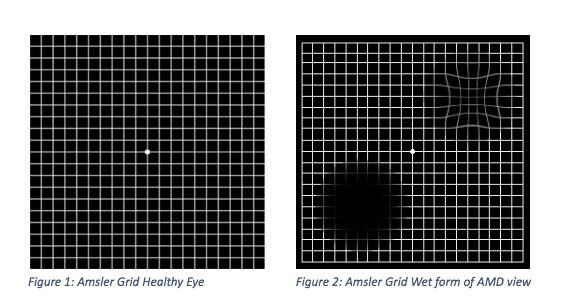

Another option for monitoring your progression from dry to wet AMD is an at home device by Notal Vision, ForeseeHome. Retina Associates of Kentucky was a site in the clinical trial for this device and now prescribes for patients with dry AMD. You take a simple 3 minute daily test to check for any changes in your vision. The response from your test is automatically transmitted to the Notal Vision Data center for tracking. If the device notices a change your physician is alerted so that we can schedule a prompt clinical examination with you.

If you have dry AMD, proper diet with a special formula of vitamins and minerals called AREDS II, based on the Age-Related Eye Disease Study II, can help preserve your vision, as well as ocular injections now available that may slow progression. If you have wet AMD, ocular injections of vision saving medicines can not only preserve your vision, but in half the patients, can reverse vision loss significantly. Your retina specialist at Retina Associates of Kentucky is uniquely trained and qualified to give you these injections and monitor your progress. In very difficult cases, Photodynamic Therapy (PDT), an older treatment, is still beneficial in controlling more aggressive forms of wet AMD.
Our physicians are encouraging early detection daily to our patients and their families and are committed to providing state-of-the-art total care for AMD patients with diagnosis, education, prevention, treatment, research, low vision services and support groups.
In addition to the content covered in this video, additional technologies and solutions have been made available, including:


